

Magento vs Shopify vs WooCommerce:
The 2026 Comparison
Stop looking for the “best” platform. Start looking for the one that matches your business DNA. Here is your definitive guide to the three giants of ecommerce.
Starting an online store in 2026 is less about finding a tool that “works” and more about choosing a philosophy. If you’ve been researching platforms, you’ve likely hit a wall of jargon. The truth is, the ecommerce world is dominated by three distinct “poles”: Shopify, Magento, and WooCommerce.
1. The Three Philosophies
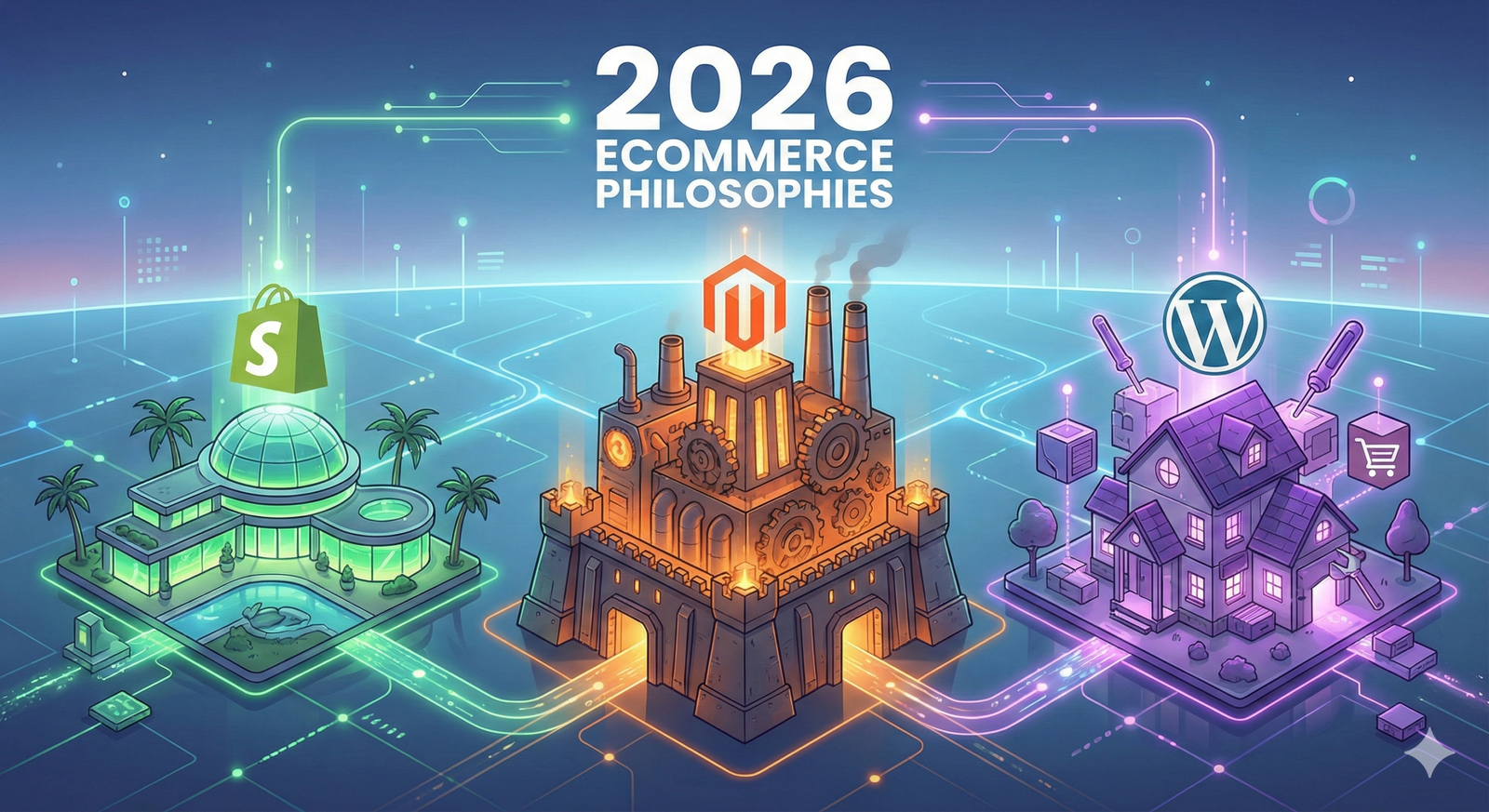
Before talking about features, you need to understand the “soul” of each platform. They aren’t just software; they are different ways of living.
Where do you want to live?
You rent a beautiful room. The pool, security, and food are handled for you. You can decorate, but you can’t knock down walls.
You buy the land and build a complex machine. You own the pipes, the power, and the output. Requires a full engineering team.
You add a shop to your existing house. It’s affordable and flexible, but you have to fix the leaky roof yourself.
2. The “Free” Myth vs. The Subscription
One of the biggest traps for new owners is looking only at the monthly fee. You need to look at the Total Cost of Ownership (TCO).
Shopify charges a “Success Tax” (transaction fees) as you grow. Magento has a massive upfront cost (CAPEX) for servers and dev. WooCommerce is variable—it can be $10/mo or $1000/mo depending on your plugins.
Where does the money go?
Shopify costs rise linearly with your sales volume.
Magento costs are massive upfront (Setup/Dev).
Woo costs depend entirely on your plugin stack.
3. The Final Verdict
So, which one should you choose? It comes down to your business model, not just the software features.
Which path should you take?
Retail / Fashion
“I just want to sell products and look good doing it.”
B2B / Industrial
“I need complex pricing, 50k+ SKUs, and IT control.”
Content / Niche
“I am a blogger/creator starting a brand.”
Starting an online store in 2026 is less about finding a tool that “works” and more about choosing a philosophy that matches your business DNA.
If you’ve been researching platforms, you’ve likely hit a wall of jargon: “Headless,” “SaaS,” “Open Source,” “TCO.” It’s enough to make any new business owner spin.
The truth is, the ecommerce world is dominated by three major players, and they couldn’t be more different. Think of them as three distinct “poles” of the digital world: Shopify, Magento (Adobe Commerce), and WooCommerce.
This guide strips away the buzzwords to help you understand the real differences, the hidden costs, and which one is actually right for you.
1. The Three Philosophies: Which Personality Are You?
Before talking about features, you need to understand the “soul” of each platform.
Shopify: The “All-Inclusive Resort”
Technically: A Multi-Tenant SaaS (Software as a Service). Simply: You are renting a room in a massive, beautiful, well-guarded building.
Shopify handles everything for you. The servers, the security, the speed—it’s all taken care of. You don’t need to know what a “load balancer” is. The trade-off? You live by their rules. You can decorate your room (theme) and add gadgets (apps), but you can’t knock down walls. If you want to do something highly unusual with your checkout process, Shopify might say “no” to protect the building’s stability.
- Best for: Brands that want to focus on marketing and selling, not fixing servers.
Magento (Adobe Commerce): The “Industrial Fortress”
Technically: A Modular Monolith. Simply: You are buying land and building a massive factory from scratch.
Magento is designed for complexity. It gives you absolute control. You own the code, the data, and the infrastructure. You can build anything you can imagine—complex B2B pricing tiers, catalogs with millions of product variations, or unique international setups. But with great power comes great responsibility (and cost). You are responsible for the foundation, the plumbing, and the security guards.
- Best for: Large enterprises with complex needs (like industrial distributors) who have a dedicated IT team.
WooCommerce: The “DIY Custom Home”
Technically: A WordPress Plugin. Simply: You are adding a storefront to your existing house.
WooCommerce turns a WordPress site into a store. It’s built on the philosophy of “democratization”—anyone should be able to sell online. It excels at storytelling because it’s married to the world’s best blogging platform. It’s incredibly flexible and starts “free,” but you have to assemble the pieces (hosting, plugins, security) yourself.
- Best for: Content-heavy brands, influencers, or startups who want flexibility without the high enterprise fees.
2. The Money Talk: The “Free” Myth vs. The Subscription
One of the biggest traps for new owners is looking only at the monthly fee. You need to look at the Total Cost of Ownership (TCO).
Shopify: The “Success Tax”
Shopify is predictable to start. You pay a monthly subscription (e.g., $39 – $399/mo). But as you grow, costs scale with you:
- Transaction Fees: If you don’t use Shopify Payments, you pay an extra fee on every sale (up to 2%).
- App Subscriptions: To get advanced features (like loyalty programs or complex returns), you might need apps that cost $500+ per month.
- Verdict: Low entry cost, but can get expensive if you have high revenue.
Magento: The “Heavy Lifter”
Magento Open Source has no license fee, but don’t be fooled—it is not free.
- Hosting: Because it’s a powerhouse, it needs powerful servers. Expect to pay $2,000+ per month just for hosting if you have high traffic.
- Development: You will need developers to maintain it.
- Verdict: High upfront cost (CAPEX), but potentially cheaper in the long run for massive businesses because there are no transaction fees.
WooCommerce: The “Variable” Option
WooCommerce is the wildcard. The core software is free.
- Hosting: You can start on cheap hosting ($10/mo), but if you grow, you’ll need enterprise hosting ($500+/mo) to keep it fast.
- Plugins: You buy features à la carte.
- Verdict: Lowest barrier to entry, but costs can creep up if you aren’t careful with paid plugins.
3. What Happens When You Grow? (Scalability)
Every new owner hopes to go viral. What happens to your store when you do?
- Shopify: It handles traffic spikes (like Black Friday) effortlessly. You don’t need to do anything. However, it has API Limits (think of it like a leaky bucket—you can only pour data in so fast). If you need to sync 100,000 products from an external warehouse instantly, you might hit a wall.
- Magento: It is the beast of big data. It uses a complex database structure (EAV) that allows it to handle massive, complex catalogs without breaking a sweat—if your servers are powerful enough.
- WooCommerce: Historically, people said it couldn’t scale. That’s changing with something called HPOS (High-Performance Order Storage). This new tech makes WooCommerce much faster for big stores. It can handle high volume now, but you need a good technical setup to ensure a bad plugin doesn’t crash your site.
4. The Final Verdict: Which One Is For You?
Based on our strategic analysis, here is the cheat sheet:
Choose Shopify if:
- You are a fashion, lifestyle, or standard retail brand.
- You want to launch fast (weeks, not months).
- You don’t want to hire a full-time engineer.
- Example: A streetwear brand dropping a new collection on Instagram.
Choose Magento if:
- You are a B2B company needing “Request a Quote” features or complex corporate accounts.
- You have a massive catalog (100,000+ items) with complex attributes (size, material, voltage, thread type).
- You require absolute control over your data and infrastructure.
- Example: A national hardware distributor selling to construction firms.
Choose WooCommerce if:
- Content is your king. You are a publisher, magazine, or influencer first, and a store second.
- You are on a budget but have some technical skills (or a friend who does).
- You want full ownership of your data but can’t afford Magento.
- Example: A cooking blog launching a line of custom spices.
Need a deeper dive? Check out our full strategic report for 5-year cost projections and technical deep dives.
